
Stargazing in Africa: A Guide to the Continent’s Night Skies


I remember the exact moment stargazing in Africa properly stopped me in my tracks. I was at Noka Camp in the Lapalala Wilderness Reserve in South Africa’s Limpopo province, lying on the outdoor sleeping deck above the Palala River. There was no moon. No glow on the horizon. Just a silence so complete I could hear my own breathing — and above me, a sky so dense with stars it felt like something had tipped a jar of diamonds across black velvet. The Milky Way didn’t just appear; it dominated. A great luminous river arching from one horizon to the other. I’d been coming to Africa for years at that point and I thought I knew what the night sky looked like. I didn’t. Not really.
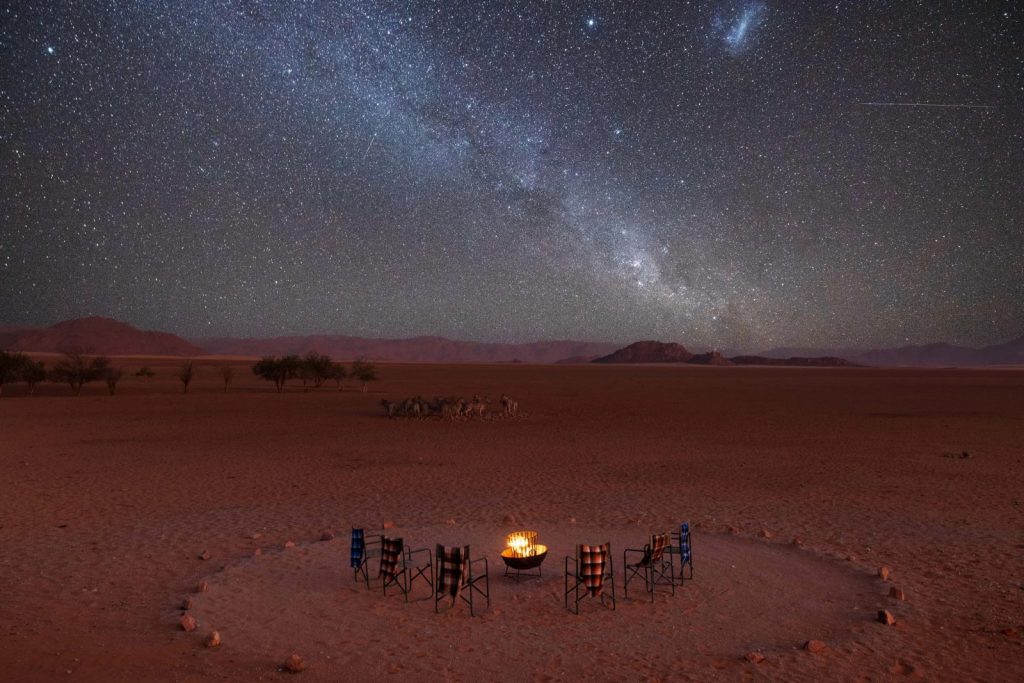
That’s the thing about stargazing in Africa. It doesn’t ease you in. It overwhelms you — in the best possible way. This continent sits largely beneath the Southern Hemisphere sky, which means you’re looking at celestial objects invisible from Europe or North America: the Southern Cross, the Magellanic Clouds (two dwarf galaxies you can see with the naked eye), and the true core of the Milky Way, blazing overhead during the dry season months of June, July and August. Combine that with vast wilderness areas, minimal light pollution across millions of hectares, and clean, dry air — and you have arguably the finest stargazing destination on Earth.
I’ve spent years travelling across Africa for Wild Paths, and in this guide I want to share the places that have genuinely moved me — from a newly designated Dark Sky Park that almost no one is talking about yet, to a remote Kalahari sanctuary where San guides share the ancient star stories of one of humanity’s oldest cultures. These aren’t generic lists. These are places I know, lodges I recommend, and skies I’ve slept under.
Why Stargazing in Africa is Unlike Anywhere Else on Earth
A few things combine to make stargazing in Africa extraordinary, and it’s worth understanding them before you go.
Light pollution is still minimal across vast areas. Much of sub-Saharan Africa remains undeveloped wilderness. National parks and private reserves the size of small countries have no roads, no towns, no electricity infrastructure — just darkness. When you’re in the Kgalagadi or the Waterberg, the nearest source of significant artificial light can be 50 kilometres or more away. The difference this makes to the sky above you is almost impossible to describe until you’ve experienced it.
The Southern Hemisphere sky is simply different. If you’ve only ever stargazed in Europe or North America, the Southern Hemisphere sky will feel genuinely alien at first — thrillingly so. You’ll lose familiar landmarks like the North Star entirely, and in their place find the Southern Cross, the great star-forming regions of the Carina Nebula, and the Magellanic Clouds — two satellite galaxies of our own Milky Way that glow like detached fragments of it, visible to the naked eye from a dark site. Kenya, sitting near the equator, offers the rare gift of seeing both hemispheres’ skies in a single night.
The dry season delivers the clearest skies. The core of the Milky Way is highest in the sky between June and August across most of Africa — which conveniently coincides with the dry season, when cloud cover is minimal and the air is crisp and clear. It’s one of the many reasons that June to October is peak safari season: the wildlife is easier to spot, the bush is more open, and the nights are spectacular.
Africa is leading a global dark sky movement. South Africa and Namibia now hold multiple internationally certified dark sky designations — including a brand new one at Lapalala Wilderness Reserve awarded in late 2025, which I’ll come to shortly. These certifications matter because they protect the skies for the future, ensuring the lodges within them commit to responsible lighting and education for generations to come.
Stargazing in Africa’s Newest Dark Sky Park: Lapalala Wilderness Reserve & Noka Camp, South Africa
I want to start here, because Lapalala is the story almost no one is telling yet — and it deserves to be shouted about.
In September 2025, Lapalala Wilderness Nature Reserve in South Africa’s Limpopo Province was designated an International Dark Sky Park by DarkSky International, becoming the first in South Africa and, remarkably, the organisation’s 250th certified Dark Sky Place globally. It sits within the UNESCO Waterberg Biosphere Reserve, spanning more than 48,000 hectares of savanna, rugged river valleys, and some of the most dramatic mountain scenery I’ve encountered anywhere on the continent. The sky quality meter readings here average 21.41 magnitudes per square arcsecond — a measurement that places it firmly among the darkest places on Earth.
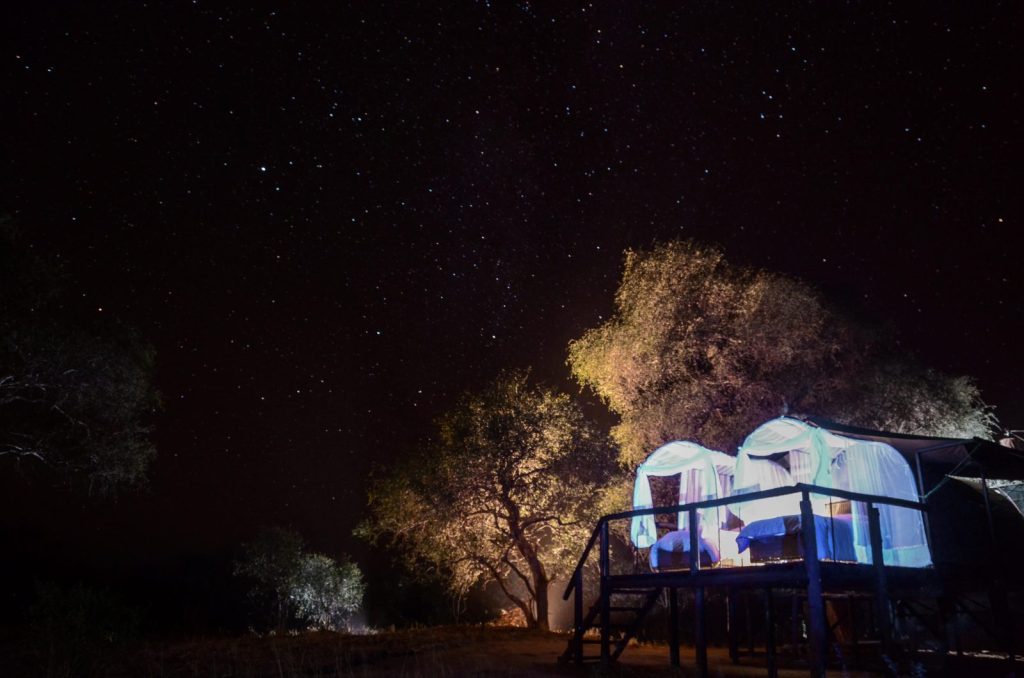
I’ve visited Noka Camp on multiple occasions, and it is genuinely one of my favourite places in all of Africa. Part of that is the space — the sheer, profound sense of remoteness. The Waterberg is mountainous and wild in a way that surprises people who picture South Africa as flat bushveld. Noka Camp sits above the Palala River, with views that stretch across forested valleys and rocky ridgelines. The camp is run by Lepogo Lodges, a not-for-profit operation — which means every single guest who stays there is directly supporting conservation. That matters to me enormously, and it’s something I always tell clients considering it.
The sleep-out deck at Noka is one of the great experiences I’ve had on this continent. You’re elevated above the river, the sounds of the bush all around you — a distant hyena, the bark of a baboon, the river moving below — and above you, once your eyes fully adjust, the sky opens up in a way that feels almost confrontational in its beauty. The Milky Way is so bright and so present that it casts a faint shadow. I’ve lain there until the small hours more than once, not wanting to look away. It is, very simply, one of the finest things I’ve ever done.
The designation wasn’t handed out easily. Achieving Dark Sky Park status required Lapalala’s management, working alongside Lepogo Lodges, to embark on a multi-year project that included a full lighting audit and the modification of more than 1,500 external fixtures across the reserve — replacing bright, blue-white lights with warm, shielded fittings, implementing a detailed Light Management Plan, and setting clear limits on when and where artificial light can be used. This is serious, committed conservation work.
Beyond the stars, Lapalala is extraordinary for its wildlife. The reserve is home to critically endangered black and white rhino, African wild dog, pangolin, lion, leopard and cheetah — I’ve walked with cheetah here, which is a memory I still return to. There are also smaller, overlooked wonders: dung beetles, which famously navigate by the Milky Way, and the Woodland Kingfisher, a migratory bird that travels at night and depends on natural darkness to find its way. When you’re protecting the sky, you’re protecting the entire ecosystem beneath it.
Lepogo Lodges offer guided night drives, dedicated astronomy experiences, and sleep-out adventures — all designed around this idea of connecting guests with the night as a living, working part of the wilderness. The sister property, Melote House, is a stunning private house overlooking a waterhole — I’ve stayed there too, and the position for wildlife watching by day and sky-watching by night is exceptional.
Lapalala is also malaria-free and just three hours from Johannesburg, which makes it surprisingly accessible for a place that feels so genuinely remote.
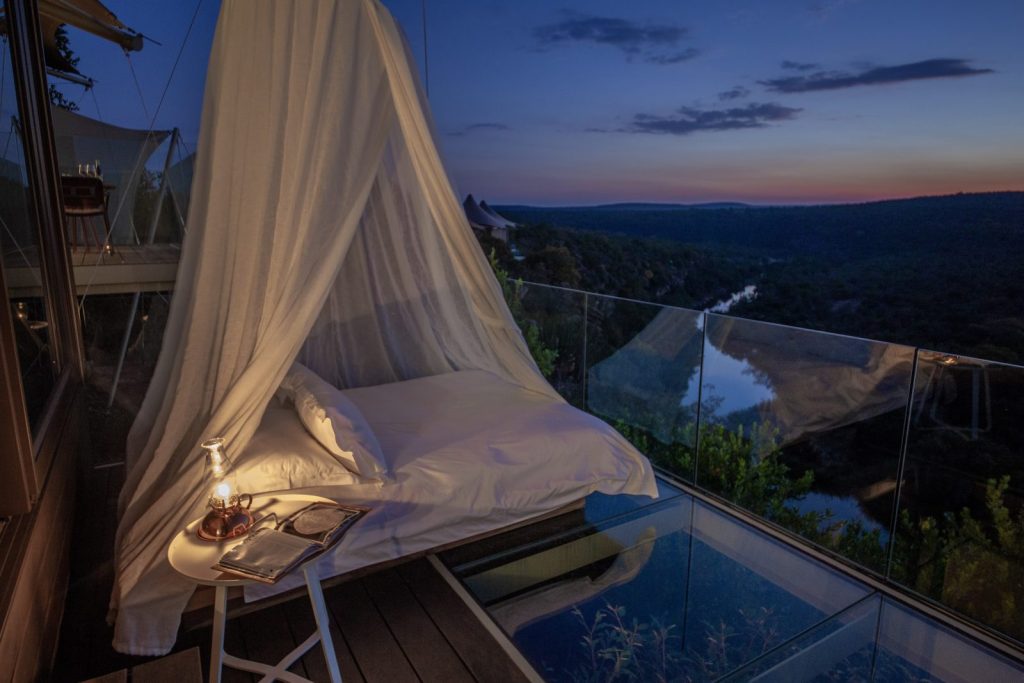
Jonny’s tip: Visit during the new moon for the darkest skies. June to August gives you the Milky Way core at its most spectacular. Book the sleep-out deck at Noka for at least one night — it’s the experience I recommend above almost anything else on the reserve.
I have a full page on Noka Camp and a dedicated blog about Lapalala on the Wild Paths site if you’d like to go deeper on what this extraordinary place has to offer.
Stargazing in the Kgalagadi Transfrontier Park, South Africa — A Dark Sky Sanctuary at the Edge of the World
If Lapalala is the dark sky story of the moment, the Kgalagadi has been quietly one of the best places for stargazing in Africa for years. This vast park — nearly 38,000 square kilometres straddling South Africa and Botswana — is one of the most remote places I’ve ever stood. The red dunes, the bleached fossil riverbeds, the silence. It is a landscape that feels stripped back to something essential, and the sky above it matches that feeling entirely.
Within the Kgalagadi sits the !Ae!Hai Kalahari Heritage Park, the ancestral homeland of the ǂKhomani San and Mier communities, which holds an International Dark Sky Sanctuary — the very highest designation in the DarkSky International programme, reserved for places of extraordinary and otherwise inaccessible darkness. The sky quality meter here reads 21.6 on a scale where 22 represents total, undiminished darkness. The nearest artificial light source from the lodge is around 50 kilometres away.
The only property inside the Heritage Park is !Xaus Lodge, community-owned and operated on behalf of the ǂKhomani San people. What makes stargazing here genuinely unlike anywhere else is the cultural dimension. Rather than simply pointing out constellations defined by ancient Greeks, the guides here share the sky stories of the ǂKhomani San — one of the oldest cultures on Earth, whose astronomical knowledge is woven into their understanding of the seasons, the rains, and the movement of animals. Telescopes are available, and the lodge has retrofitted all external lighting to be fully night-sky friendly. But my honest advice is to put the telescope down at some point and just lie on your back in the dune sand. Few things on this planet compare to it.
By day, the Kgalagadi delivers too. The black-maned Kalahari lions are iconic. Cheetah, leopard, and the extraordinary sociable weaver nests that stud the camel thorn trees. The red dunes at sunrise, when the light turns the landscape the colour of embers. This is a place that works on you slowly, and then all at once.
Jonny’s tip: Combine a Kgalagadi visit with a fly-in from Johannesburg or Cape Town — the drives in are long. Stay at least three nights to let the pace and the darkness properly get under your skin.
Stargazing in Africa’s Original Dark Sky Reserve: NamibRand Nature Reserve, Namibia
If you want to trace the origins of Africa’s dark sky movement, you come here. The NamibRand Nature Reserve in Namibia was the continent’s first certified dark sky location — an International Dark Sky Reserve, a step above the Park designation — and for many astronomers and serious stargazers it remains the benchmark for stargazing in Africa. The reserve covers an enormous expanse of Namib Desert, its landscapes shifting between red dune fields, gravel plains, and isolated inselbergs rising from the flat, and on a clear night — which is almost every night — the sky is staggering.
What the Namib offers that few other places can match is absolute dryness. The desert air contains almost no moisture, which means atmospheric distortion is minimal and stars burn with a steadiness and clarity that photographs can only approximate. The Milky Way here is not a smear. It is a structure — you can see the dark dust lanes cutting through it, the brighter clouds of star formation, the subtle colour gradations from the hot blue-white of young stars to the cooler amber of older ones. It is the sky as it truly is, rather than the version most of us have spent our lives seeing.
Wolwedans, a stunning collection of lodges and camps deep in the reserve, has the commitment to dark skies baked into the design of every structure — and is one of southern Africa’s most beautifully conceived properties full stop.
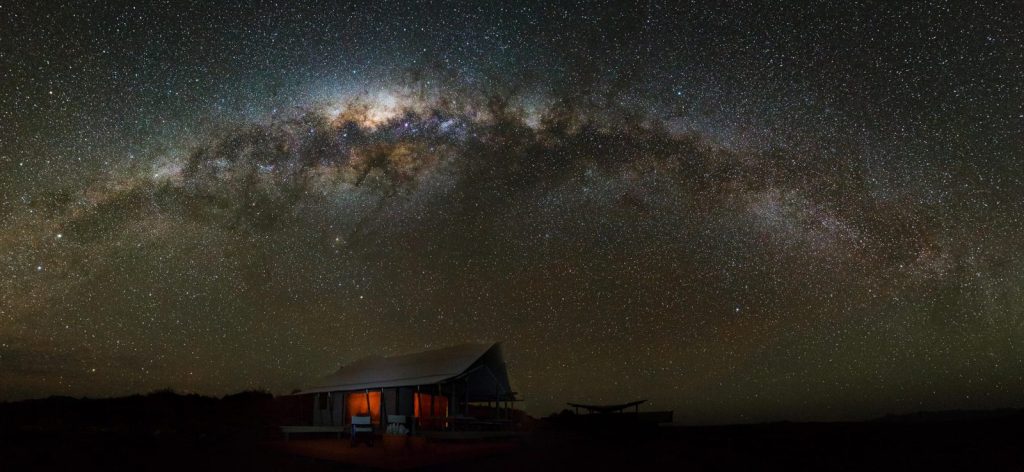
Jonny’s tip: Plan around the new moon and visit between May and September when the summer cloud cover over Namibia clears entirely. The Milky Way core is highest in the sky from June onwards.
Stargazing in Northern Kenya at Sarara — Samburu Sky Stories
Northern Kenya is a different Africa from the one most people visit first. The Mathews Range, where Sarara sits within the 850,000-acre Namunyak Wildlife Conservancy, is remote, mountainous, and astonishingly beautiful — and the stargazing in Africa’s far north is as good as anywhere on the continent. The skies here are not formally certified, but they don’t need to be. When darkness falls in the Mathews Range, it falls absolutely.
What elevates Sarara beyond simply being a place with a dark sky is the person who takes you into it. Tilas, one of Sarara’s Samburu guides and a lifelong student of the night sky, leads stargazing sessions that root the celestial world in Samburu culture and history. As pastoral nomads, the Samburu have always navigated by the stars — the sky is not abstract to them, it is a practical map, a cultural archive, and a spiritual landscape. Mars, for instance, is Loiba Lpayani — ‘the star that doesn’t like lazy men’. Spending an hour under the Mathews Range sky with a guide like Tilas is one of those experiences that makes you think differently about both the stars and the people beneath them.
Sarara’s fly camping offer is particularly good for stargazing — a night spent in a dry lugga (riverbed), a fire burning low, and above you the same sky that Samburu warriors have navigated for generations. The Sarara Treehouses have star beds on their raised platforms, and the exclusive-use Sarara Wilderness camp in the wider Samburu Ecosystem offers equally dark and beautiful night skies.
The Namunyak Conservancy is also home to Kenya’s second-largest elephant population, African wild dog, lion, leopard, Grevy’s zebra and the elegant gerenuk. This is properly wild Kenya, a long way from the Mara, and all the more rewarding for it.
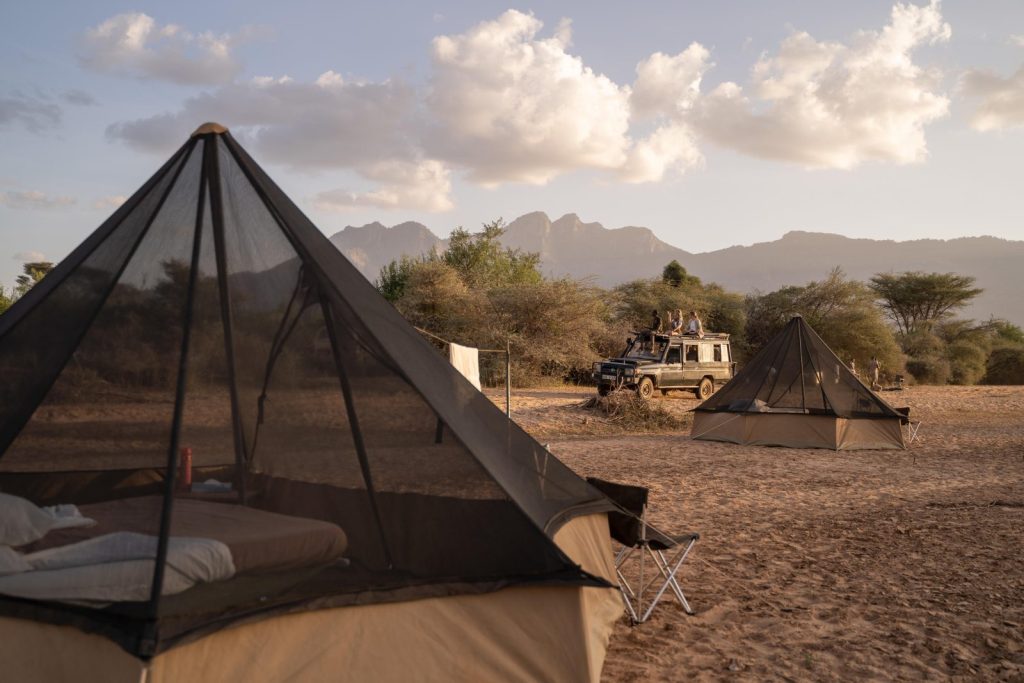
Jonny’s tip: Sarara pairs beautifully with a Samburu National Reserve visit or a stop at the Reteti Elephant Sanctuary — one of the most moving conservation experiences in Africa. Fly in from Nairobi Wilson Airport; the journey is part of the experience.
Stargazing in Botswana: The Makgadikgadi Pans — The Sky’s Mirror
There is nowhere quite like the Makgadikgadi for stargazing in Africa. One of the largest salt pans in the world, it stretches across northeastern Botswana in an expanse of flat, bleached white that at times looks more like the surface of another planet than anything on Earth. In the dry season, it becomes an enormous, unbroken horizon — and when the stars come out, you understand immediately why people speak about this place with something close to reverence.
With no trees, no hills, no structures of any kind for miles, the sky here is total. It meets the earth in a perfect circle around you. The Milky Way reflects off the salt crust on still nights in a way that makes it genuinely difficult to tell where the sky ends and the ground begins. I’ve heard more than one person describe it as the most disorienting, overwhelming experience of their lives — in a way that feels like a compliment of the highest order.
Lodges like Jacks Camp and Camp Kalahari, run by Uncharted Africa, are among Africa’s most distinctive properties — deeply embedded in the landscape and culture of the Makgadikgadi. Beyond stargazing, this area is home to meerkats, brown hyenas, and in the green season, vast herds of zebra and wildebeest moving across the flooded pans. Leroo La Tou Camp offers an incredible sleep out experience in the pans, this is miles away from anywhere and is truly once in a lifetime experience.
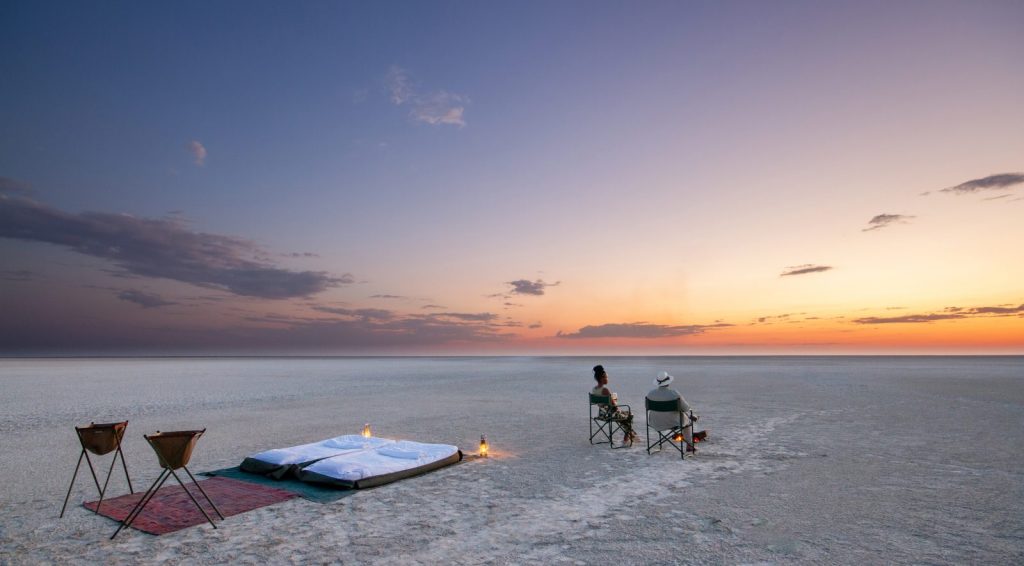
Jonny’s tip: The best stargazing is in the dry season, May to October, when the pans are white and the skies are cloudless. Ask your camp about sleeping on the pan itself under the stars — some operators offer this as an unforgettable add-on.
Stargazing in Kenya at Kipalo Hills, Tsavo — Stars Above the Red Earth
Kipalo Hills occupies a dramatic position perched on the Mbulia Hills, looking out across the red earth and rough scrubland of Tsavo towards the distant silhouette of Kilimanjaro. It is not the most famous camp in Kenya, which is precisely part of its appeal. The Mbulia Conservancy is quiet, private, and genuinely off the tourist trail — and the skies above it are correspondingly spectacular.
The Tsavo ecosystem is enormous and wildly beautiful, known for its red-dust-coated elephants — Kenya’s largest population — and for a landscape that shifts between open savannah, baobab woodland, lava fields, and rocky kopjes. At night, with the conservancy entirely dark and the nearest town a long drive away, the sky delivers something that guests coming straight from Nairobi or Mombasa are rarely prepared for.
Kipalo runs entirely on solar power and is staffed almost entirely by local community members — the camp was built by locals, is led by local guides and trackers, and its conservation fees flow directly into protecting wildlife and supporting the Mbulia community. The Cliff Villa has a private plunge pool and a rooftop terrace from which you can stargaze in complete privacy. Night drives in the conservancy turn up civets, bush babies, aardvark and other nocturnal species alongside the stars.
Wild Paths works with Kipalo Hills and I genuinely love this camp — it offers something that the bigger, more polished properties can’t always manage: a sense of being completely, authentically in the African bush, with a sky above you that has never heard of light pollution.
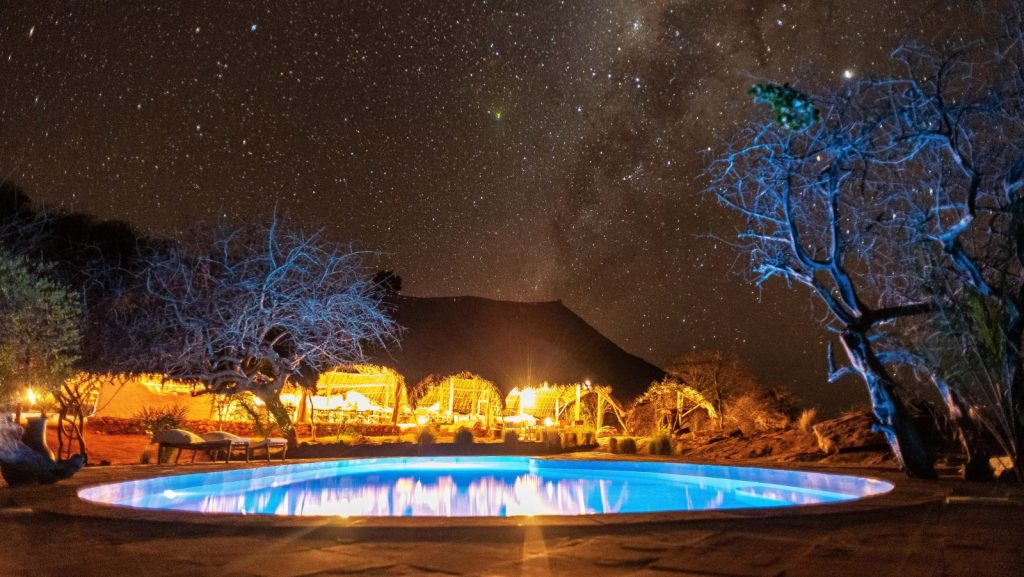
Jonny’s tip: Take the train from Nairobi down to Voi and you’ll be collected by the Kipalo Hills team and driven straight to camp. Travelling across Kenya by train is a fun and affordable way to experience Kenya. Take a look at our Kenya Safari and Beach by train itinerary.
Stargazing in Zimbabwe: Hwange National Park — Big Sky, Big Game
Zimbabwe’s largest game reserve is not talked about enough, and that relative anonymity is part of what makes it such a rewarding destination for stargazing in Africa. Covering more than 14,000 square kilometres of pristine wilderness, with very little artificial light for hundreds of kilometres in any direction, Hwange delivers the kind of darkness that feels like a physical sensation — a quality of quiet and blackness that you notice the moment you step out of camp.
Hwange is famous for its elephant herds, which can number in the thousands around the waterholes in the dry season — an extraordinary, almost primeval sight. Lions, wild dog, leopard, sable antelope. And then, once the fire at camp has burned to embers and the generators cut out for the night, one of the finest skies in southern Africa opens above you.
Some of the best camps in the region — including Linkwasha, Little Makalolo and Davison’s Camp — actively incorporate stargazing into the guest experience, with guides who can walk you through the southern sky and the mythology that surrounds it. Zimbabwe camps tend to have a warmth and intimacy that I find genuinely hard to beat anywhere in Africa, and combining that hospitality with nights like these makes for a trip people talk about for years.
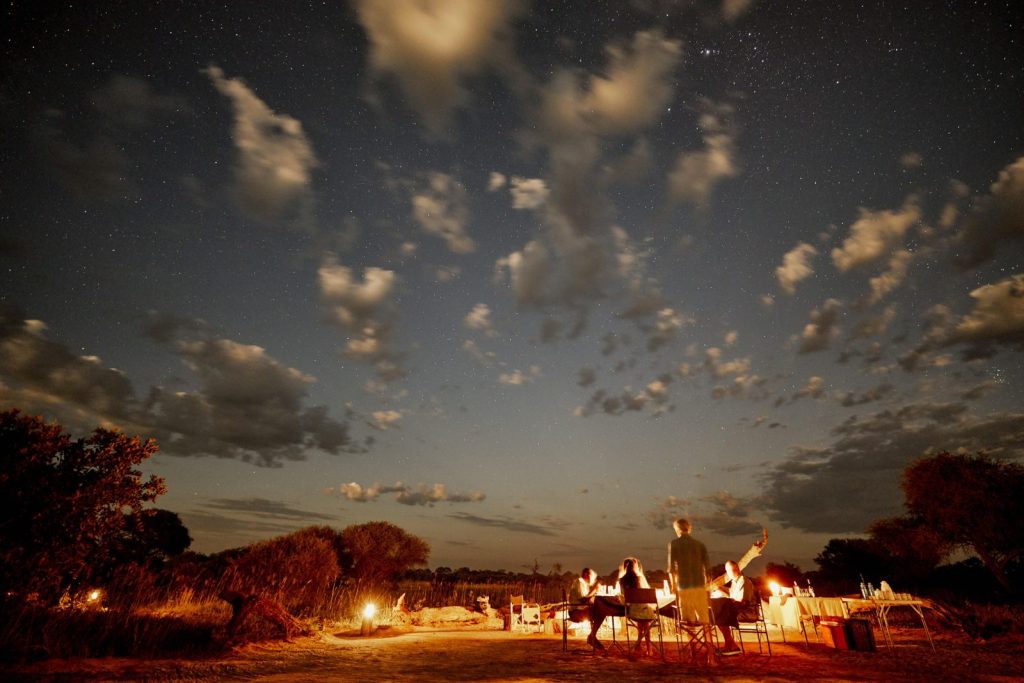
Jonny’s tip: Time a Hwange visit during the dry season (May to October). A new moon period in July or August is the sweet spot — you get the wildlife spectacle by day and the Milky Way at its peak by night.
Practical Tips for Stargazing in Africa
After years of planning safari trips built around the night sky, here’s what I tell every client who’s specifically interested in stargazing in Africa:
- Plan around the lunar calendar. A full moon, beautiful as it is, washes out the stars significantly. A new moon — when the moon rises and sets with the sun — gives you the darkest possible skies. Most good safari operators can tell you the moon phases for your dates; it’s worth building your trip around them if stargazing is a priority.
- June, July and August are generally the best months. The dry season across most of sub-Saharan Africa means fewer clouds, crisper air, and the core of the Milky Way sitting highest in the sky. Kenya near the equator has good stargazing potential year-round, but the long rains (April–May) are best avoided.
- You don’t need a telescope. The most unforgettable moments I’ve had have been entirely naked-eye — lying on my back in a dark place and simply looking up. That said, binoculars open up another layer: the Magellanic Clouds, the Orion Nebula, globular clusters. If your camp has a telescope, use it, but don’t feel you’re missing out without one.
- Protect your night vision. Red-light torches are standard at good camps for exactly this reason — white light destroys your dark adaptation in seconds, and it takes 20–30 minutes to fully recover. Ask your camp for a red torch if they don’t provide one automatically.
- Ask for a guide who knows the cultural sky. The Samburu, the San, the Shona — indigenous African peoples have been reading this sky for tens of thousands of years. A guide who can connect the stars to those stories turns stargazing into something far richer than astronomy.
- Go somewhere with formal dark sky credentials where possible. Lapalala (South Africa), NamibRand (Namibia), and the Kgalagadi’s !Ae!Hai Heritage Park (South Africa) all hold internationally certified dark sky status — meaning they’ve made a formal, ongoing commitment to protecting their skies.
Frequently Asked Questions
What is the best country in Africa for stargazing?
Namibia and South Africa are the two standout destinations. Namibia’s NamibRand Nature Reserve was Africa’s first certified dark sky location and remains one of the clearest, driest places on Earth for night sky viewing. South Africa now has two certified locations — the !Ae!Hai Kalahari Heritage Park (International Dark Sky Sanctuary, the highest designation) and the newly designated Lapalala Wilderness Reserve (International Dark Sky Park, certified in late 2025). Kenya is exceptional if you want the cultural dimension of stargazing alongside safari, and Botswana’s Makgadikgadi Pans offer an experience unlike anywhere else on Earth.
When is the best time to stargaze in Africa?
June to August is the prime window across most of southern and eastern Africa. The dry season delivers consistently clear skies, and the core of the Milky Way is highest overhead during these months — giving you the most dramatic possible view. Plan your specific nights around the lunar calendar: a new moon is significantly better than a full moon for dark sky viewing. Kenya near the equator is good year-round, but avoids the long rains of April and May.
What can you see in the African night sky?
From a truly dark location in Africa, you can see the Milky Way as a structured, three-dimensional object — not just a haze, but a galaxy you can trace in detail. With the naked eye you can also spot the Large and Small Magellanic Clouds (two dwarf galaxies orbiting our own), the Southern Cross and its two pointer stars Alpha and Beta Centauri, the Orion Nebula, and on a good night the Andromeda Galaxy. Binoculars reveal the Eta Carinae Nebula, globular clusters including Omega Centauri (the largest in the Milky Way), and countless star fields invisible from the Northern Hemisphere.
Do I need any special equipment?
No. The most important piece of equipment is a dark location, and if you’re visiting any of the reserves mentioned in this guide, you already have that. Beyond that, a pair of 8×42 binoculars transforms the experience considerably. A red-light torch is essential for moving around camp without destroying your night vision. Stargazing apps like SkySafari or Stellarium are genuinely useful for orientation, but ask your guide first — they usually know the sky better than any app.
Is it safe to stargaze in Africa?
At any reputable safari lodge or camp, absolutely. Guided stargazing experiences are led by trained rangers who know both the sky and the bush around them. Unguided stargazing away from camp in areas with dangerous wildlife is not something I’d recommend — but within the perimeter of a camp, or on a guided experience, it’s simply one of the safest and most magical things you can do.
Plan Your Stargazing Safari with Wild Paths
I’ve been lucky enough to lie under some of the finest skies on this planet — at Noka Camp above the Palala River, on the salt pans of the Makgadikgadi, in the deep desert of the Kalahari. Every time, it does the same thing: it makes you feel very small and very alive simultaneously. That combination, I think, is what people come back from safari talking about when they run out of ways to describe the wildlife.
If you’d like to build a trip that puts the night sky at its heart — whether that’s a stay at Noka Camp in newly designated Lapalala, a fly-camping experience under the Samburu stars at Sarara, or a journey through the dark sky parks of southern Africa — I’d love to help you plan it. At Wild Paths, I design every itinerary personally, drawing on the places I know and love. Get in touch and let’s find your sky.
Jonny May
Founder
Wild Paths
About the Author:
Wild Paths was founded by me, Jonny May, a passionate Africa specialist with a deep-rooted desire to transform the travel industry. For the past 15 years, I’ve been fortunate enough to travel extensively across Africa. I’ve driven from Cape Town to Cairo, traversed the Sahara while leading camping safaris, and stayed in everything from community huts to the most exclusive private houses on the continent.

More From The Blog
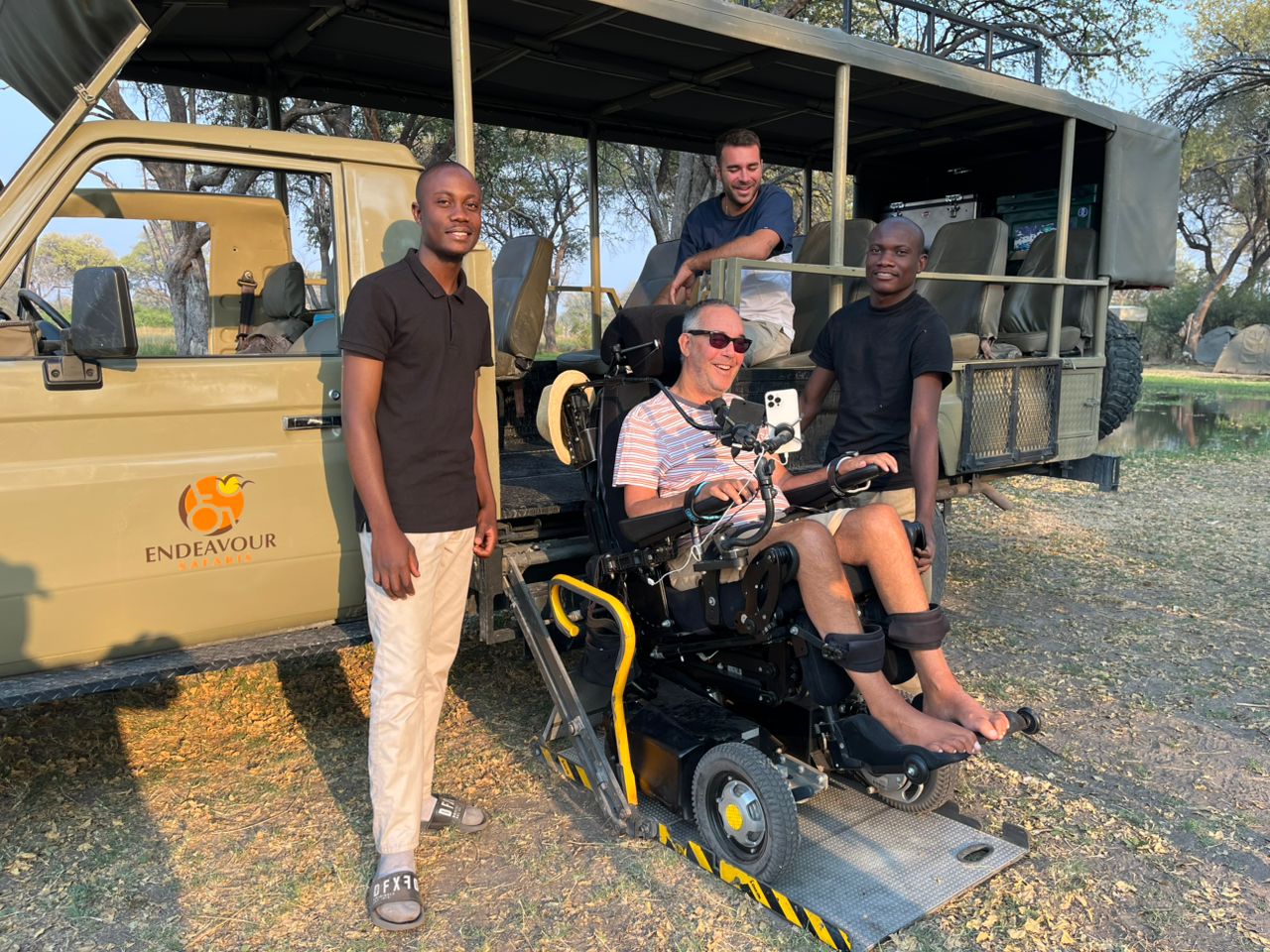
Can wheelchair users go on safari?
It's one of the questions I'm asked most often, and the honest answer is: yes. For most of my career in the safari industry, however, the more truthful answer...

Where to See Namibia’s Best Wildlife
Namibia is a wildlife lover’s paradise, offering a unique combination of desert-adapted species, abundant national parks, and breathtaking landscapes....

5 Reasons to visit Lapalala Wilderness Reserve
The Lapalala Wilderness Reserve, in the malaria free Waterberg region of South Africa is still relatively unknown; but it’s an area that I highly...